Across the country, state corrections departments are struggling to recruit and retain enough staff to operate prisons safely and effectively. The Safe Inside project brings together findings from a 50-state analysis to help state leaders understand challenges and identify steps to strengthen the corrections workforce.

When state departments of correction cannot recruit and retain enough staff, the effects ripple across safety, budgets, and the lives of people working and living inside.
Across states with comparable data, assaults on staff increased 77 percent, assaults between incarcerated people rose 54 percent, and deaths in custody were 47 percent higher in 2024 than in 2019. Understaffing increases stress, reduces access to programs, and heightens risk for everyone inside.
State departments of corrections employ more than 200,000 officers nationwide, making departments of corrections among the largest state employers. More than one million people are incarcerated in state prisons on a given day. Staffing shortages affect millions of families connected to both staff and incarcerated people.
State corrections departments spent over $2 billion on overtime in 2024, nearly twice the amount in 2019. Corrections agencies represent about 15 percent of state workers but account for 40 percent of overtime spending. Heavy reliance on overtime raises costs and increases burnout without resolving underlying staffing shortages.


Most states have increased officer pay, resulting in a 33 percent rise in average salaries between 2017 and 2024. States are also implementing a wide array of initiatives, but it remains unclear which approaches sustainably improve recruitment and retention and which may carry costs for safety, culture, or workforce health. States are taking many different approaches to the same challenge. Some examples are highlighted below.
Go to the Data and Workforce Assessment


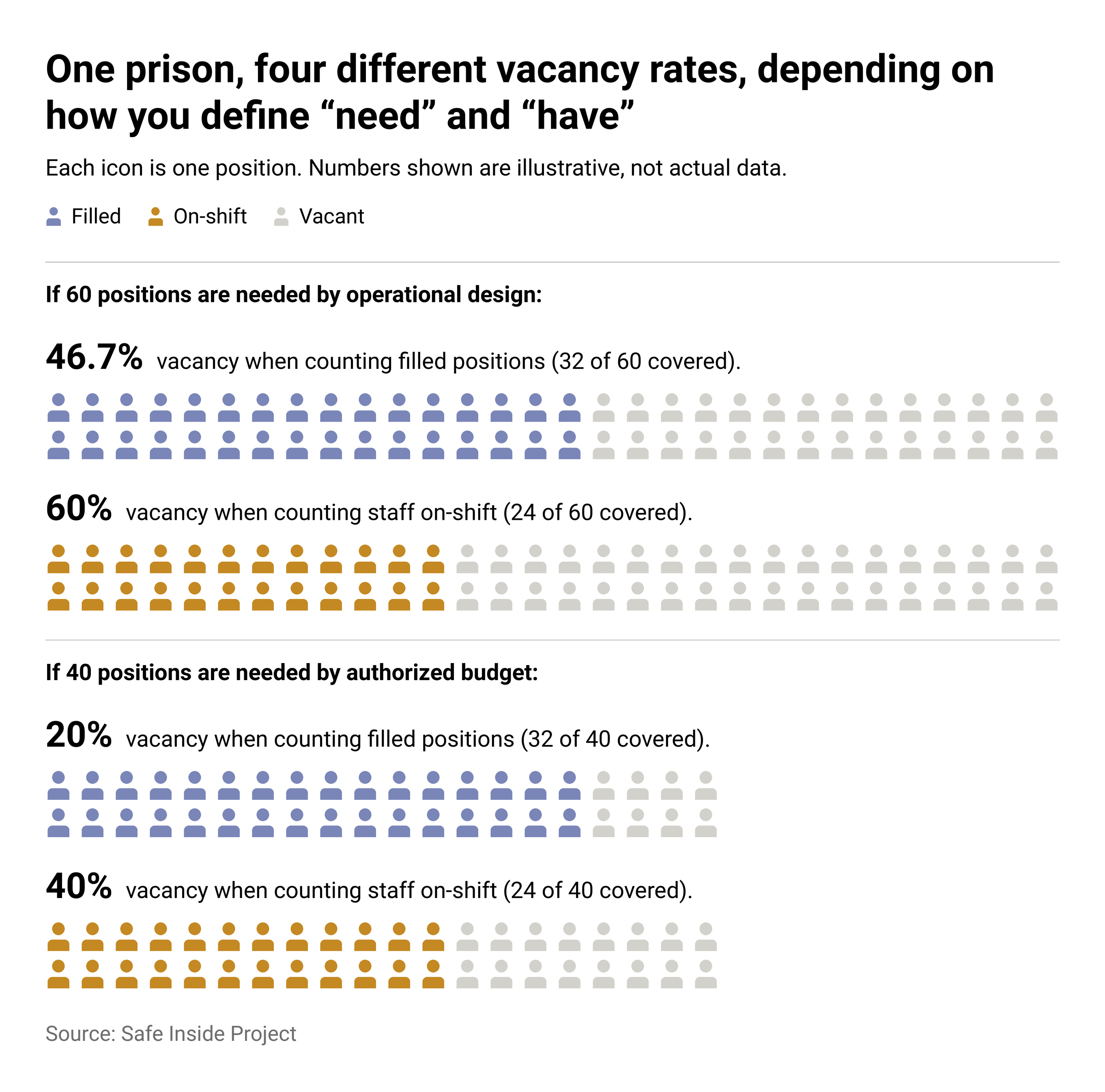
Public data on corrections staffing and safety are limited, inconsistent, and often outdated. Many states publish only a few of the key metrics needed to understand workforce conditions or identify risks. Without complete, comparable information, leaders cannot fully see where staffing shortages are most severe or whether changes are working.
Six key indicators were examined: vacancy rates, turnover, overtime, compensation, workforce size, and officer salaries. Complete data for all six were available in just over half of states, with major differences in how and how often data are reported.
* Indicates states where partial data or alternate data points were used.
Of 14 key indicators reviewed—including assaults, deaths in custody, lockdowns, and program cancellations—only one is reported consistently across all states. About half of agencies publish data on assaults or deaths, and far fewer release information on other safety conditions.
Get updates on new insights, reports, and progress from the Safe Inside initiative.

There is no single fix for the staffing challenges state corrections departments are facing, but progress is within reach. States can act now by improving how they collect and use data to design strategies, measure progress, and troubleshoot problems.
Better data—and better use of data—lead to better outcomes.