


The 50-state analysis shows consistent patterns of workforce strain across departments of corrections. Vacancy, turnover, and safety data point to systems stretched thin and in need of sustained attention.
Download the ReportDepartments of corrections are contending with a shrinking workforce and rising demands. A national labor shortage, competition from other public safety jobs, and the remote locations of many prisons make it difficult to recruit and retain officers.
Staffing challenges in state departments of corrections have wide-ranging consequences because these agencies employ a large share of the state workforce and touch the lives of millions of people nationwide.
Departments of Corrections employ roughly one out of every 5 state workers, making them among the largest agencies in state government.
More than one million people are incarcerated in state prisons on any given day. As a result, staffing shortages affect millions of people, including corrections officers, incarcerated individuals, and their families.
Rates of assaults on both staff and incarcerated people have risen sharply across most state prison systems.
Deaths in custody have increased 47 percent since 2019.
Corrections officers face the highest rates of workplace violence in the country — nearly twice those of law enforcement officers and far above other occupations.
As departments struggle to fill vacant positions, states have increasingly relied on overtime to maintain prison operations, driving substantial and growing fiscal costs.
Overtime spending in state corrections departments has surged, rising by more than 100 percent since 2019 in many states and by nearly 200 percent in some.
Corrections employees make up about 15 percent of state workers but account for roughly 40 percent of all state overtime spending.
States have raised corrections officer pay, but salaries still lag far behind other law enforcement. On average, corrections officers earn about $21,000 less per year than police officers.
Some departments have lowered vacancy rates, only to see them rise again. Vacancies in Vermont fell from a pandemic peak of 21.5 percent to 12.9 percent in mid-2024, but crept back up to nearly 15 percent by the end of that year. Nebraska dropped from 527 open positions in 2021 to 359 in 2023, then back up to 452 in 2024.
Turnover remains high. Across 23 states, about one in six corrections employees leave their jobs each year. This churn keeps pressure on recruitment and training.
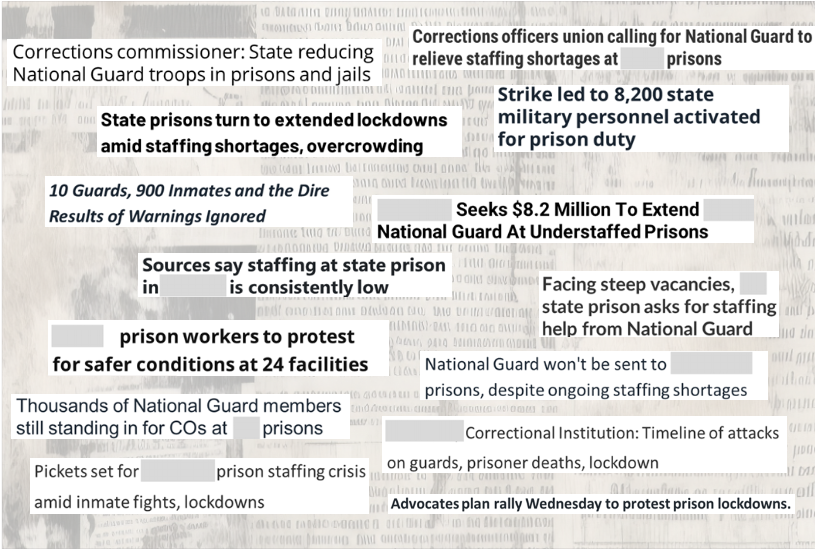
Staffing shortages continue to make headlines in many states, showing that even with higher pay and new initiatives, the workforce remains unstable and needs sustained attention.
State departments of corrections face a dual challenge. They must rebuild a stable workforce while continuing to operate safe, well-run facilities. Addressing this challenge starts with ensuring leaders have timely, reliable data about their workforce and the conditions inside facilities. This information is essential to designing effective recruitment and retention strategies.
Better data can inform staffing decisions, but the path forward cannot focus only on hiring more officers. State leaders must also consider how to reduce demands on existing staff and operate more efficiently. Safe Inside is designed to elevate data, highlight shared challenges across states, and create space for learning and collaboration around what it takes to build safer, more stable corrections systems.

This project is supported by Grant No. 15PBJA-23-GK-05377-MUMU awarded by the Bureau of Justice Assistance. The Bureau of Justice Assistance is a component of the U.S. Department of Justice’s Office of Justice Programs, which also includes the Bureau of Justice Statistics, the National Institute of Justice, the Office of Juvenile Justice and Delinquency Prevention, the Office for Victims of Crime, and the SMART Office. Points of view or opinions in this document are those of the authors and do not necessarily represent the official position or policies of the U.S. Department of Justice.
Arnold Ventures provides additional support for Safe Inside, which is conducted in partnership with the Correctional Leaders Association.